One flavour, two formats: how a fruit profile is kept the same in a pressed tablet and a soft chew
A small own-label line often comes in two formats at once: a pressed tablet and a soft chew, each in the same handful of fruit flavours. On the shelf the promise looks simple. Mango is mango, whichever format you pick up. Behind the shelf it is one of the harder things a small maker can attempt, because the two formats share almost nothing except the name on the front.
A pressed tablet is a dry powder squeezed into shape in a fraction of a second. A soft chew is a hot, wet syrup that sets slowly over a day or two. One carries flavour in a dry matrix that barely moves; the other carries it in a moist gel that keeps changing for weeks. Sweetness reads differently in each, acid lands at a different moment, and the aroma that makes a strawberry smell like a strawberry escapes from them at different speeds.
This guide walks through how a flavour profile is built, how each format is made, how the two are matched against each other, and how the match is held over a shelf life. It is written for readers who want to know what sits behind the words "same flavour, two formats", and what a careful maker checks before they are allowed to put those words on a label.
1. Why a flavour does not simply transfer
It is tempting to think of a flavour as an ingredient: buy the mango flavour, add it to both recipes, done. In practice a flavour is a performance, and the format is the stage. Three things change between a dry pressed piece and a moist chew, and each one alters what the eater perceives.
- Release. A pressed piece breaks down quickly and releases most of its aroma in the first few seconds. A chew releases slowly as it is worked, so the first and last impression differ.
- Heat history. The chew is cooked, often well above the boiling point of water, and the most delicate aroma notes are the first to leave. The pressed piece never sees heat beyond the friction of the press.
- Water. Water carries acid and sweetness to the tongue. A moist chew delivers them evenly; a dry piece delivers them in a burst as it dissolves.
The consequence is that the same flavour, added at the same rate, produces two noticeably different results. Matching them means building each recipe separately toward a common target, not copying one into the other.
2. The anatomy of a fruit profile
Flavourists describe a fruit in layers. The top notes are the light, volatile compounds that reach the nose first: the green snap of a fresh apple, the bright lift of a cut strawberry. The middle notes carry the body and character of the fruit. The base notes are heavier, sweeter and slower, and they linger after the piece is gone. A good fruit profile has all three in proportion. A flat one has lost its top.
Alongside the aroma sit two taste elements that do not reach the nose at all: the acid, which gives a fruit its brightness, and the sweetness, which rounds it off. Each fruit has its own natural acid, and choosing the right one matters more than most people expect. Malic acid tastes like apple because apples are full of it. Citric acid tastes like citrus. Use the wrong acid and the fruit is recognisable but slightly off, the way a photograph with the wrong white balance still shows the right scene.
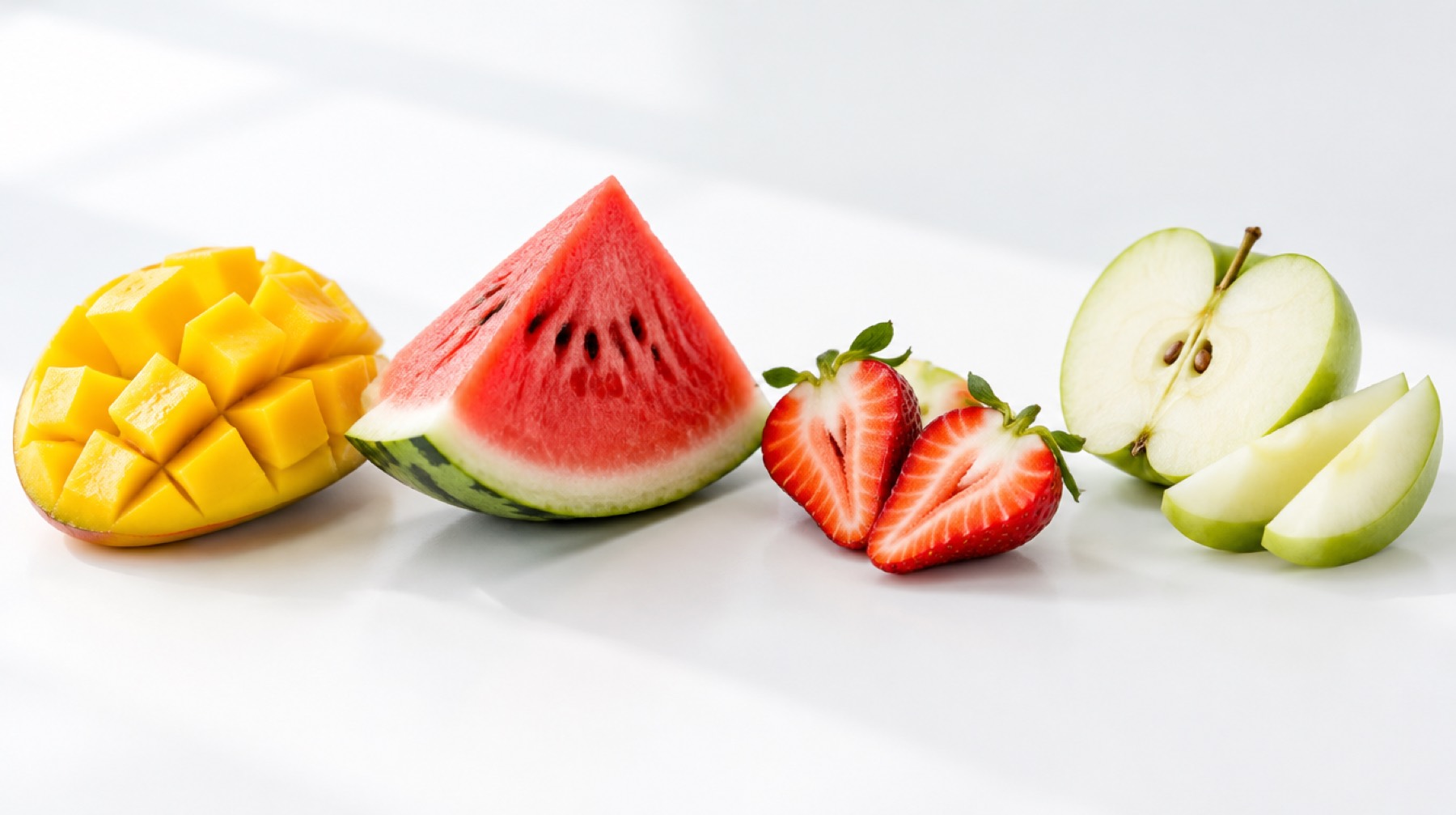
| Fruit profile | Character of the top notes | Natural acid to lean on | What fades first |
|---|---|---|---|
| Mango | Tropical, slightly resinous, a faint peach-like warmth | Citric, with a touch of malic | The resinous lift, leaving a generic sweet fruit |
| Watermelon | Very light, green, cucumber-like freshness | Malic, used sparingly | The green freshness, which is the most volatile of the four |
| Strawberry | Fruity, jammy, with a fresh green edge when ripe | Citric and malic together | The fresh edge, so the profile drifts toward jam |
| Green apple | Sharp, crisp, distinctly green | Malic, used generously | The sharpness, if the acid migrates or the coating absorbs water |
How four common fruit profiles are built, which acid supports each, and which part of the profile is lost first in storage. The last column is where a stability programme looks hardest.
The last column of that table is the reason flavour matching does not end on the day of production. Every profile loses something over time, and it is almost always the top. A matched pair that tastes identical in week one can drift apart by month three if the two formats lose their top notes at different speeds, which they usually do.
3. Sweetness and acid: the balance that sells the fruit
Most of what people call "flavour" in a fruit sweet is really the ratio between sweetness and acid. Too sweet and every fruit tastes the same. Too sharp and the fruit disappears behind the sourness. The target is different for each fruit: green apple wants a high acid note, watermelon a low one, mango and strawberry somewhere between.
The two formats deliver this balance in different ways. In a soft chew, acid is usually added twice: some inside the cooked mass, and some on the outside as a sanding of acid and sugar crystals tumbled over the set pieces. The outer layer is what produces the sharp first impression of a "sour" chew. In a pressed piece, acid is blended into the powder, and the whole balance arrives at once as the piece breaks down. To get the same first impression from a pressed piece, a maker might use a coarser acid crystal that dissolves a fraction later, or a slightly higher level overall to compensate for the lack of an outer layer.
Sweetness has a similar split. Chews are built on sugars and syrups that are also the structure of the piece. A pressed piece uses sugars or sugar alcohols chosen partly for how well they compress, and some of those are noticeably less sweet or carry a cooling note of their own. That cooling note is fine in a mint and distracting in a mango, so the choice of bulk sweetener in the pressed format is as much a flavour decision as a mechanical one.
4. The pressed format: powder, pressure and a few hundredths of a second

A pressed piece starts as a dry blend: the bulk sweetener, the acid, the flavour, a colour, a small amount of a flow aid so the powder runs evenly, and a lubricant so the pieces release from the tooling. Flavour in a dry blend is usually supplied as a spray-dried powder, in which the liquid flavour has been locked inside a carrier. This protects the top notes until the piece meets moisture, which is exactly when the eater should notice them.
The blend is fed into a die, and two punches close on it from above and below. The whole event takes a fraction of a second. What comes out is decided by a short list of settings, each of which a careful maker records for every run.
| Setting or check | What it controls | What goes wrong when it drifts |
|---|---|---|
| Fill weight | How much powder each piece contains | Pieces vary in size and in how much flavour each carries |
| Compression force | How hard the piece is pressed | Too low: crumbly. Too high: glassy, slow to break down, flavour arrives late |
| Press speed | Time the powder spends under pressure | Faster runs can trap air and cause pieces to split in layers |
| Hardness | Force needed to break a piece, measured on a sample | A drift signals a change in the blend or the tooling |
| Friability | How much a piece wears when tumbled | High wear means dust in the pack and chipped edges |
| Breakdown time | How quickly a piece softens in the mouth | The whole flavour timing shifts with it |
The settings recorded on a pressed run and the in-process checks that confirm them. Hardness and weight are sampled at fixed intervals, not only at the start.
Two of these rows matter most for flavour. Compression force sets how quickly the piece breaks down, and therefore when the top notes arrive. A piece pressed too hard can taste weaker than one pressed correctly from the same blend, simply because the flavour arrives late and in a trickle. Fill weight sets how much flavour each piece carries. Uniform weight is not a cosmetic concern; it is the reason every piece in the pack tastes like every other.
Uniformity starts before the press. A dry blend can separate as it moves: fine particles sink, coarse ones rise, and the flavour powder may not stay evenly spread. A maker checks blend uniformity by taking samples from the top, middle and bottom of the blender and confirming they agree before any powder reaches the press.
5. The soft chew: cook, deposit, rest, finish
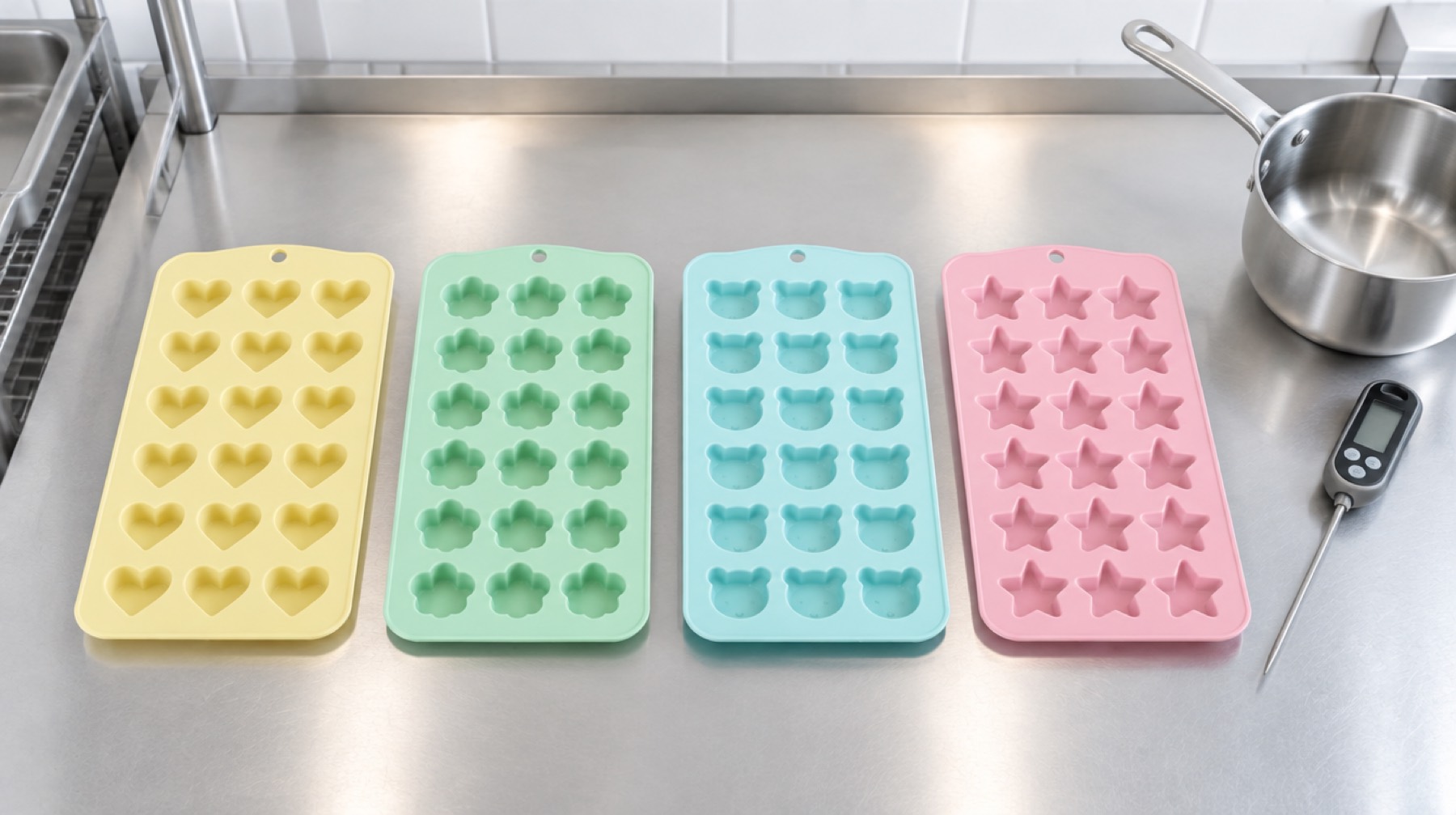
A soft chew is made in four stages, and each one has a lever that changes the flavour.
- Cook. Sugars, syrups and water are heated to a target temperature that sets the final solids. The gelling agent, usually pectin for fruit chews, is added at a point that depends on the recipe.
- Deposit. The hot mass is filled into moulds. Flavour, colour and the inner acid are often added at the very last moment before depositing, to limit how long the top notes spend in the heat.
- Rest. The pieces set and lose moisture over one to two days in a controlled room. This is where the final texture develops, and also where some aroma is quietly lost.
- Finish. The set pieces are released, then sanded with sugar and acid or given a light oil polish so they do not stick together.
Pectin is the natural choice for fruit flavours because it sets cleanly, releases flavour quickly and gives a short, fruit-jelly bite. Its quirk is that it depends on acid to set. Add the acid too early and the mass begins to set in the pan; too late and it may not set evenly in the mould. That timing is one of the reasons the inner acid level in a chew is not a free choice: part of it is structural, and only the remainder is available for flavour. The outer sanding is where the maker gets the freedom back.
The key number for a chew is not its moisture content as such but its water activity: how much of the water in it is free to move. Water activity decides whether the piece stays soft, whether the sanding stays crisp or turns sticky, and how quickly the flavour changes in storage. A chew is rested until it reaches a target water activity, and that target is written into the batch record next to the cook temperature.
6. Matching the pair: how "the same flavour" is tested
Matching two formats is done by tasting, but not casually. The usual approach has three parts.
First, a reference standard. For each flavour the maker keeps a description in words and a retained sample from an approved batch, stored in conditions that slow its change. Every new batch of either format is compared against the reference, not against the previous batch, so small drifts do not stack up over time.
Second, a small trained panel. Four to eight people who taste regularly and use the same vocabulary: top note strength, acid timing, sweetness, aftertaste, any off note. Panellists score each attribute on a short scale. The scores matter less than the agreement between them. When the panel disagrees, the descriptors are refined before anyone argues about the product.
Third, a difference test when a change is made. The classic version presents three samples, two alike and one different, and asks the taster to pick the odd one out. If the panel can reliably spot the changed sample, the change is noticeable and the recipe goes back to the bench. If they cannot, the change is accepted. It is a simple test, and it removes a great deal of opinion from the process.
Matching across formats adds one practical rule: compare at the moment of eating, not at the moment of smelling. A pressed piece and a chew can smell identical in the jar and still taste different, because one releases its aroma in a burst and the other gradually. Panels that only sniff tend to approve pairs that customers then describe as "not quite the same".
7. Colour: matching what the eye expects
People taste with their eyes first. A watermelon piece that is the wrong shade of pink tastes less like watermelon to most people, even when the recipe is unchanged. So colour is part of the flavour match, and it is harder to match across formats than it looks.
A chew is translucent: light passes into it, and the colour reads deep and glossy. A pressed piece is opaque: light bounces off the surface, and the same colour reads paler and chalkier. To look like a pair, the pressed format usually needs a stronger or slightly different shade. Colours from fruit and vegetable sources behave differently again in each format, as some shift with acid and some fade under light. A maker settles the colour of each format on a lightbox against a printed reference card, under the same light every time, and records it.
8. Holding the match over a shelf life
A pair that matches on day one is only half the job. The match has to last as long as the date on the pack, and the two formats age in different ways.
| What changes | Pressed piece | Soft chew |
|---|---|---|
| Main enemy | Humidity: the piece absorbs water, softens and goes dull | Both directions: dries and hardens in dry air, sweats and sticks in damp air |
| Aroma loss | Slow, as the flavour is protected inside the dry carrier | Faster, as the moist gel lets volatile notes travel to the surface |
| Acid behaviour | Stable unless moisture gets in | Outer sanding can draw water and turn tacky |
| Colour | Can fade at the surface under light | More stable inside, but the sanding can cloud |
| Best storage | Cool, dry, sealed, away from light | Cool, stable humidity, sealed, away from heat |
How each format ages and what it needs from storage. The best-before date on each pack assumes the storage instruction printed beside it.
To set a date with confidence, a maker runs a stability programme: samples from a production batch are stored under the labelled conditions and opened at fixed points, such as one, three, six and nine months. At each point the panel compares them with the reference standard, and simple measurements are repeated: hardness and weight for the pressed piece, water activity and texture for the chew. The date printed on the pack is the last point at which both formats still matched the reference, with a margin.
9. Packaging chosen per format
Because the two formats fail in different ways, they rarely belong in identical packaging, even when the outer design matches.
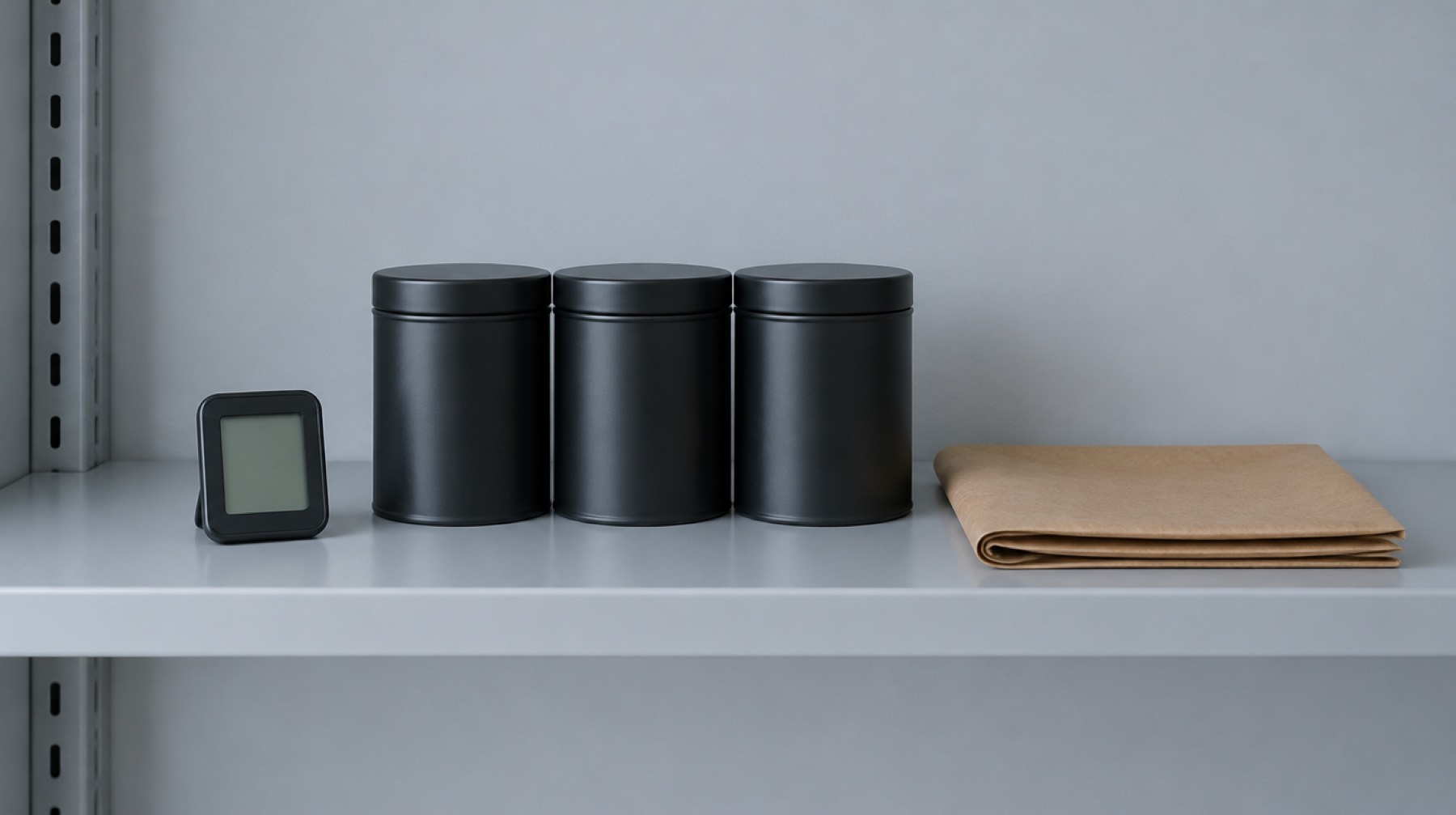
- Pressed pieces need a strong moisture barrier: a sealed tin, a lined carton, or a jar with an induction-sealed liner. A small food-grade desiccant sachet is common.
- Soft chews need a stable atmosphere rather than a dry one. A desiccant would pull water out of them and harden them. A resealable laminated bag with a good seal is typical.
- Both benefit from opaque packaging, because light fades colour and speeds up the loss of delicate aroma notes.
- Both need a tamper-evident first opening, so the customer can see the pack has not been opened since it was sealed.
A practical detail that is often missed: once opened, a pressed pack and a chew pack behave very differently in a kitchen cupboard. The label is the only place to tell the customer that, so a careful maker prints a short "once opened" line suited to each format.
10. What the label has to say for a flavoured line
A flavoured line puts a little more on the label than a plain one. The flavour name has to be honest about where the taste comes from. Many regions distinguish between a product that tastes of a fruit because it contains that fruit, one flavoured with natural flavourings, and one flavoured with other flavourings, and the wording on the front is expected to follow that distinction.
Colours are listed in the ingredients, and some colours carry their own required statements in some markets. Allergens matter here too: chews are sometimes made on shared lines with products containing milk, soy or nuts, and the polishing agents used to stop pieces sticking can include ingredients that some people avoid. The lot number and best-before date, printed on the unit itself, tie every pack back to the batch records described above, and the storage instruction printed next to the date tells the customer what conditions that date assumed.
11. Ten questions to ask about any two-format flavour line
Everything above reduces to a short list. A maker who can answer these plainly is running a matched line. A maker who cannot is selling two products that share a name.
- Is there a written reference standard and a retained sample for each flavour?
- Is each format built toward the reference on its own, or is one recipe copied into the other?
- Which acid is used for each fruit, and why that one?
- Is blend uniformity checked before pressing?
- Are fill weight and hardness sampled throughout a pressed run, not only at the start?
- Is the chew rested to a target water activity, and is that value recorded per batch?
- Is a difference test run whenever a recipe or supplier changes?
- Is colour matched on a lightbox against a reference card?
- Was the best-before date set by a stability programme run on both formats?
- Does each format have packaging chosen for how it actually ages?
12. The mistakes small lines make most
- One flavour rate for both formats. The pressed piece tastes weak and the chew tastes strong, or the other way round.
- Matching by smell instead of by eating. The jar test passes and the mouth test fails.
- Comparing each batch with the last one. Small drifts add up until the line no longer resembles the reference.
- A desiccant in the chew bag. The pieces harden within weeks.
- A date copied from one format to the other. The two age differently, so one of the dates is a guess.
- Clear packaging for a light-sensitive colour. The pack fades on the shelf before the date is reached.
A closing note
"Same flavour, two formats" is four words on a label and several months of work behind them. The work is mostly invisible: a reference sample in a cool cupboard, a page of panel scores, a hardness reading every twenty minutes, a water activity value written next to a cook temperature, a hygrometer that someone reads every morning. None of it shows on the front of the pack. All of it shows the first time someone tries the second format and finds that it tastes the way they expected. This guide was written so that the work behind that moment is easier to recognise.